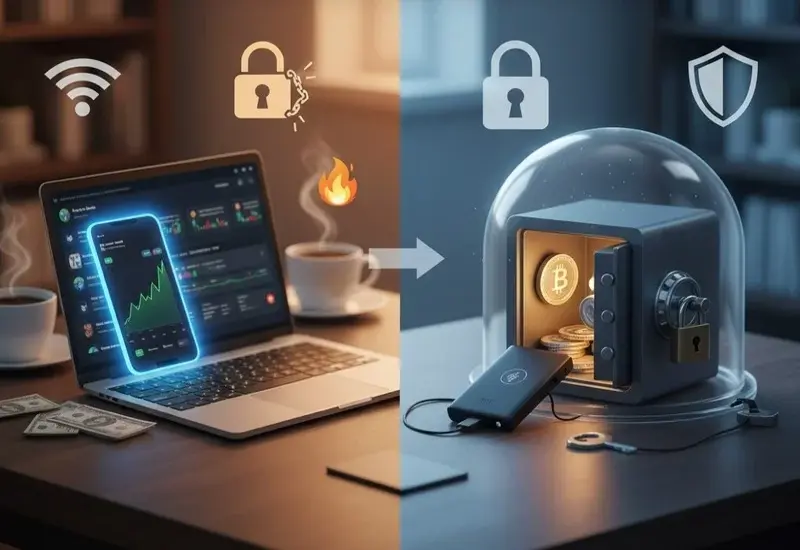
As soon as you buy your first cryptocurrency, one big question hits you right away: Where do I actually keep it?
Unlike regular money sitting safely in a bank account—with FDIC insurance and a customer service team to help if things go wrong—crypto puts the responsibility almost entirely on you. There’s no one to call if you mess up, so choosing the right way to store it is absolutely critical.
This is where hot vs. cold wallets come into play. Understanding the key differences between these two can literally be the difference between sleeping easy knowing your investment is safe… or losing everything to a hacker, scam, or simple mistake.
In this straightforward guide, we’ll clearly explain what hot and cold wallets are, lay out their pros and cons, and help you figure out which one (or combination) makes the most sense for where you are right now. Plus, you’ll discover the smart, balanced strategy that most experienced crypto holders use to get the best of both security and everyday convenience.
Quick Decision Guide – Which Wallet is Right for You?
| If Your Situation Is… | Recommended Wallet | Why? |
| “I just bought my first $100.” | Exchange Wallet (Hot) | Easy, free, and perfect for learning the ropes. |
| “I own $1,000+ in crypto.” | Hardware Wallet (Cold) | The value justifies the cost of a device for safety. |
| “I trade crypto every day.” | Software Wallet (Hot) | Instant access to markets and DeFi applications. |
| “I am ‘HODLing’ for years.” | Hardware Wallet (Cold) | Maximum protection against hacks and exchange failures. |
Now that you’ve figured out which type of wallet best matches where you are right now, let’s dig into the real reasons behind those recommendations. The table gave you a quick guide, but at the heart of crypto storage is one big trade-off everyone faces: security versus convenience.
To make smart choices that protect your money over the long haul, it’s worth understanding how these “digital vaults” actually work behind the scenes. In the sections ahead, we’ll break down exactly how hot and cold wallets function, look at the main software and hardware options out there, and call out the serious risks you absolutely need to watch out for.
First things first—let’s bust the most common myth in crypto: what a wallet actually is and does.
Understanding Crypto Wallets: The Basics
Before we dive into hot versus cold wallets, let’s first understand what a cryptocurrency wallet actually is. Specifically, this will help clarify some common misconceptions.
What is a Crypto Wallet?
A cryptocurrency wallet doesn’t actually “store” your crypto. Instead, your cryptocurrency always exists on the blockchain. Moreover, what your wallet stores are your private keys—the passwords that prove you own the cryptocurrency and allow you to send it.
Think of it this way:
- The blockchain = A giant vault building with safe deposit boxes
- Your public address = Your box number (everyone can see it)
- Your private key = The unique key that opens only your box
- Your wallet = The keychain holding your key
Consequently, “storing crypto” really means “storing your private keys securely.” Therefore, whoever controls the private keys controls the cryptocurrency.
The Golden Rule: “Not Your Keys, Not Your Crypto”
This phrase is crucial for beginners to understand. Specifically, if someone else holds your private keys (like an exchange), you don’t truly own your crypto—they do. Moreover, you’re trusting them to give it back to you when you ask.
Therefore, the type of wallet you choose determines whether you or someone else controls your cryptocurrency.
What is a Hot Wallet? (Connected to the Internet)
Now let’s explore hot wallets in detail. A hot wallet is any cryptocurrency wallet that is connected to the internet. Consequently, it’s always accessible online for quick transactions.
Think of it like your checking account—convenient and always available, but not the safest place for all your money.
Types of Hot Wallets: Which Software is Best?
While all hot wallets are connected to the internet, they offer different levels of control and risk. Use the table below to find the right tool for your needs.
| Wallet Type | Control Level | Best For… | Examples |
| Exchange | Low (Custodial) | Beginners & frequent traders. | Coinbase, Binance |
| Software | High (Self-Custody) | Users who want control on their phone/PC. | Trust Wallet, Exodus |
| Browser | High (Self-Custody) | Interacting with NFTs and DeFi apps. | MetaMask, Phantom |
Though hot wallets vary in how they handle your private keys, they all share one common trait: they are ‘live’ on the internet. This makes them the ultimate agility tool—allowing you to swap tokens or buy NFTs in seconds. But because they are always connected, they should never be used as a long-term vault. For the portion of your portfolio that you are going to carry for months or even years, you want to turn off the internet and go completely cold.
What is a Cold Wallet? (Offline Storage)
Now, let’s talk about cold wallets—they work in a completely different way. A cold wallet is simply a crypto wallet that’s never connected to the internet, which makes it pretty much impossible for hackers to reach it online.
Picture it like a safety deposit box at a bank: it’s a bit less convenient to access whenever you want, but it’s way safer for storing your most valuable stuff.
Basically, cold storage is all about keeping your private keys totally offline and away from the internet. Hardware wallets are generally considered the best option out there, but there are also some good old-school methods worth knowing about.
Types of Cold Wallets
| Method | Security | Cost | Our Recommendation |
| Hardware Device | Maximum | $50–$200 | Top Choice: Most secure and user-friendly. |
| Steel Backup | Maximum+ | $30–$100 | Essential: Use this to fireproof your seed phrase. |
| Paper Wallet | High | Free | Avoid: Fragile and easy to lose or mismanage. |
Here’s the key takeaway: if you’re serious about protecting your crypto investments, a hardware wallet is absolutely essential—there’s really no debating it.
Paper wallets were pretty popular back in Bitcoin’s early days, but these days, they’re mostly outdated for most people. The risks of physical damage (like losing or damaging the paper) or simple user mistakes make them a lot less reliable.
By getting a proper hardware wallet, you basically eliminate the two biggest threats: online hacks and human errors. It gives you real peace of mind knowing your assets are safe, no matter what happens to an exchange or even if the internet goes down.
Hot vs. Cold Wallets: Direct Comparison
To help you decide, let’s compare them side by side:
| Feature | Hot Wallet | Cold Wallet |
|---|---|---|
| Internet Connection | Always online | Offline |
| Security Level | Medium | Maximum |
| Convenience | Very convenient | Less convenient |
| Cost | Free | $50-200 |
| Access Speed | Instant | Few minutes |
| Best For | Small amounts, trading | Large amounts, holding |
| Hacking Risk | Higher | Minimal |
| User Responsibility | Lower (exchange) / Higher (software) | Complete |
| Recovery Support | Often available | Your responsibility |
| Learning Curve | Easy | Moderate |
Which is Safer for Beginners? The Balanced Approach
Now for the crucial question: Which should you use? Honestly, the answer isn’t strictly one or the other. Instead, most experienced investors use both strategically.
The Smart Strategy: Use Both
For Small Amounts (Under $500): Use a reputable exchange hot wallet or trusted software wallet. Specifically:
- Coinbase, Kraken, or Binance for exchanges
- MetaMask or Trust Wallet for software
- Enable Two-Factor Authentication (2FA)
- Use strong, unique passwords
Why this works: Convenience outweighs risk for small amounts. Moreover, you can access your crypto easily when needed.
For Large Amounts (Over $500-1,000): Transfer to a hardware cold wallet. Specifically:
- Ledger or Trezor hardware wallet
- Store the bulk of your holdings
- Think of it as your “savings account”
Why this works: Maximum security for significant investments. Additionally, you have true ownership.
The Checking vs. Savings Analogy
Think of your crypto storage like traditional banking:
Hot Wallet = Checking Account
- Keep what you need for daily use
- Easy to access
- Convenient for transactions
- Don’t keep your life savings here
Cold Wallet = Savings Account / Safety Deposit Box
- Store majority of assets
- Harder to access (intentionally)
- Maximum security
- For long-term holdings
Consequently, balance convenience with security based on your needs.
Essential Security Practices for Both Wallet Types
Regardless of which wallet type you use, follow these crucial security practices:
1. Enable Two-Factor Authentication (2FA)
First and foremost, always enable 2FA on exchange accounts:
- Use authenticator apps (Google Authenticator, Authy)
- Avoid SMS 2FA when possible (can be intercepted)
- Backup your 2FA codes securely
Consequently, even if someone gets your password, they can’t access your account.
2. Use Strong, Unique Passwords
Additionally, password security is crucial:
- Minimum 12 characters
- Mix of letters, numbers, symbols
- Unique for each crypto account
- Use a password manager
Therefore, hackers can’t guess or brute-force your passwords.
3. Beware of Phishing and Scams
Moreover, stay vigilant against scams:
- Double-check URLs before logging in
- Never click suspicious links in emails
- Verify addresses before sending crypto
- Be skeptical of “too good to be true” offers
Consequently, you won’t fall victim to common scams.
4. Secure Your Recovery Phrase
Finally, your seed phrase (recovery phrase) is critical:
- Write it down on paper (never digital)
- Store in multiple secure locations
- Never share with anyone
- Consider fireproof/waterproof storage
Important: Anyone with your seed phrase can steal all your crypto. Therefore, treat it like your most valuable possession.
5. Start Small and Learn
Furthermore, don’t rush into large investments:
- Buy $10-50 of crypto first
- Practice sending and receiving
- Get comfortable with the process
- Gradually increase as you learn
Consequently, you won’t make costly mistakes with large amounts.
Common Beginner Mistakes to Avoid
Now let’s discuss mistakes that beginners often make:
Mistake 1: Keeping Everything on an Exchange
The problem: Leaving $10,000+ on Coinbase indefinitely
The risk: Exchange hacks, bankruptcies, account freezes
The solution: Transfer significant amounts to cold storage
Mistake 2: Buying Hardware Wallets from Amazon/eBay
The problem: Purchasing from third-party sellers
The risk: Devices might be tampered with or have compromised firmware
The solution: Only buy directly from manufacturer websites (Ledger.com, Trezor.io)
Mistake 3: Storing Seed Phrase Digitally
The problem: Taking photos or saving in cloud storage
The risk: Hackers can access cloud accounts and steal your funds
The solution: Write on paper, store in multiple physical locations
Mistake 4: Not Testing with Small Amounts
The problem: Sending $5,000 without testing first
The risk: Wrong address means permanent loss
The solution: Always send $5-10 test transaction first, confirm receipt, then send the rest
Mistake 5: Using Public WiFi for Crypto Transactions
The problem: Accessing wallets on coffee shop WiFi
The risk: Hackers on the same network can intercept data
The solution: Only use secure, private networks or mobile data
When to Upgrade from Hot to Cold
As your crypto holdings grow, you’ll need to transition. Therefore, here are the guidelines:
Keep in Hot Wallet (Exchange or Software):
- Under $500: Risk is relatively low
- Actively trading: Need quick access
- Learning phase: Getting comfortable
Move to Cold Wallet:
- Over $500-1,000: Risk becomes significant
- Long-term holding: Won’t need frequent access
- Significant investment: Can’t afford to lose it
The trigger point: When losing the amount would genuinely hurt financially, it’s time for cold storage.
Step-by-Step: Setting Up Your First Hardware Wallet
If you’re ready for a cold wallet, here’s the process:
Step 1: Purchase the Device
- Buy directly from Ledger.com or Trezor.io
- Choose your model based on needs
- Wait for delivery (don’t rush)
Step 2: Verify Device is Genuine
- Check for tamper-evident seals
- Verify packaging is original
- Ensure device is new, not used
Step 3: Initialize the Device
- Follow manufacturer instructions carefully
- Generate your seed phrase on the device
- Device should generate phrase (never pre-written)
Step 4: Write Down Seed Phrase
- Write all words in order
- Double-check spelling
- Store securely immediately
Step 5: Test with Small Amount
- Send $10-20 to the wallet
- Practice receiving
- Practice sending back
- Confirm everything works
Step 6: Transfer Main Holdings
- Once comfortable, transfer larger amounts
- Send in batches if nervous
- Verify each transaction
Key Takeaways: Choosing the Right Wallet
To summarize, here are the essential points:
Hot Wallets:
- Connected to internet, convenient but less secure
- Good for small amounts and frequent trading
- Free to use, easy for beginners
- Vulnerable to hacking and exchange failures
Cold Wallets:
- Offline storage, maximum security
- Good for large amounts and long-term holding
- Cost $50-200 but worth it for security
- Require more responsibility and care
The Balanced Approach:
- Use hot wallets for spending money (<$500)
- Use cold wallets for savings (>$500-1,000)
- Think checking account vs. savings account
- Adjust based on your comfort and holdings
Essential Security:
- Enable 2FA on all accounts
- Use strong, unique passwords
- Protect your seed phrase
- Be vigilant against scams
- Start small and learn gradually
Final Thoughts: Your Crypto Security Journey
In the end, it’s not about choosing hot wallets or cold wallets and sticking to one forever. It’s about knowing what each one is good for and using them smartly together.
As you go further on your crypto journey, your approach to storage will naturally change. Most people start out using hot wallets because they’re quick and convenient for everyday stuff. Then, as your holdings grow and become more valuable, you’ll start moving the bulk of it into cold storage for safety. Over time, you’ll also get much more comfortable with all the security best practices.
The real goal is finding the right balance between security and usability. Don’t lock your crypto up so tightly that it’s a hassle to actually use it when you need to. But at the same time, never chase convenience so much that you risk losing everything.
One last thing: the fact that you’re here researching this stuff already puts you way ahead of most beginners. By putting these strategies into practice, you’ll be able to protect your investments properly while still enjoying everything this exciting technology has to offer.
Keep learning, stay cautious, and enjoy the ride!
Ready to secure your cryptocurrency?
- Learn about gas fees before making transfers
- Understand how to avoid scams that target wallet users
- Master blockchain basics to understand how wallets work
- Start buying your first crypto on a reputable exchange
- Explore volatility management for long-term success
New to crypto? It’s often easiest to keep your first purchase in a trusted exchange wallet (a ‘hot wallet’). Once you’ve built up your holdings, the best move is to upgrade to a hardware wallet (cold storage) to keep your investment safe offline.
External Resources:
- Ledger: Hardware Wallet Guide – Official security best practices
- Trezor: Wallet Comparison – Hardware wallet information
- CoinDesk: Crypto Wallet Guide – Additional learning
Disclaimer: This article is for educational purposes only. You are responsible for the security of your cryptocurrency. Hardware wallets offer significant security advantages but require careful use. Always follow manufacturer instructions and never share your seed phrase with anyone.
Disclaimer: This article is for educational purposes only and is not financial advice. Cryptocurrency is highly volatile and risky. Only invest money you can afford to lose. Past performance is no guarantee of future results. Always do your own research and consider consulting a qualified financial advisor.
