[TL;DR] Dollar-Cost Averaging (DCA) is the easiest way for beginners to invest in crypto without stressing over prices. You buy a fixed amount regularly (e.g., $50 weekly in Bitcoin), averaging costs over time. It reduces risk from volatility, removes emotional decisions, and works great long-term—even in dips. Start small, automate it, and avoid stopping during crashes. Advanced twists: value-based buys or add staking for extra rewards.
If you’ve been following cryptocurrency news, you’ve probably seen the wild price swings. Moreover, you’ve likely wondered: “When is the best time to buy?” Furthermore, you might be worried about buying right before a crash. However, there’s a strategy that can help you avoid these concerns entirely.
In this comprehensive guide, we’ll explain dollar-cost averaging crypto—a simple yet powerful investment strategy perfect for beginners. Therefore, by the end of this article, you’ll understand how to invest in cryptocurrency without trying to time the market. Additionally, you’ll learn why this approach reduces risk and stress.
Table of Contents
What is Dollar-Cost Averaging? The Simple Answer
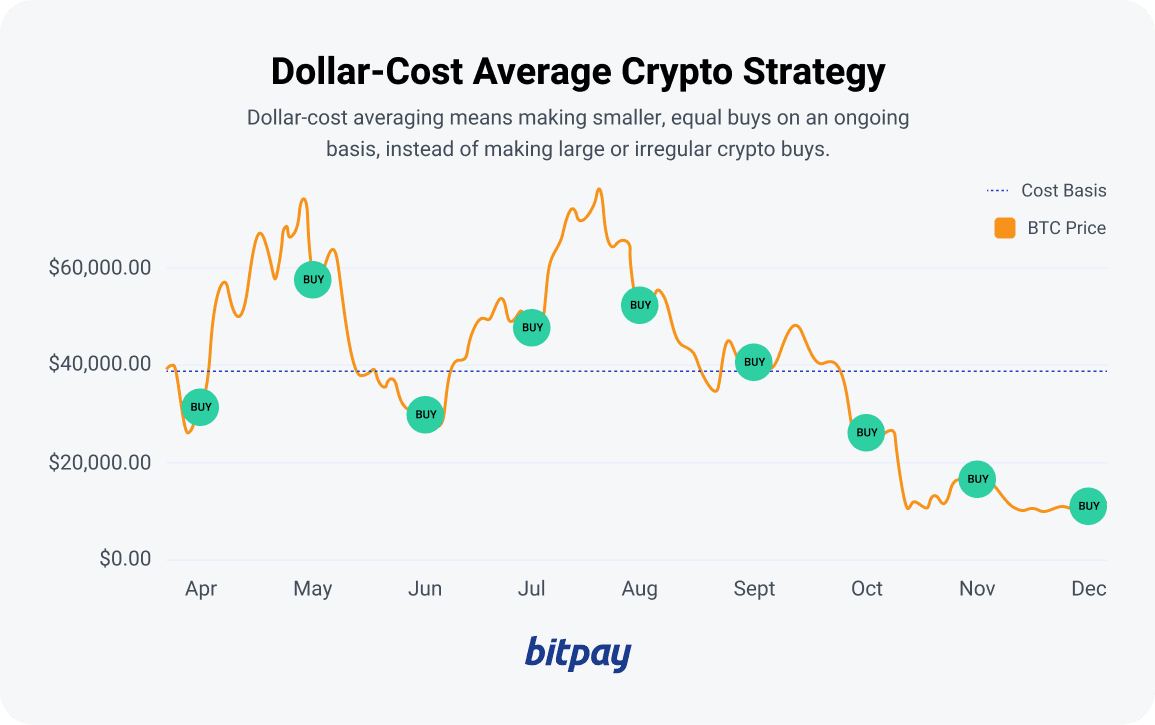
DCA Explained: Dollar-Cost Averaging (DCA) is a strategy where an investor divides the total amount to be invested into periodic purchases of a target asset to reduce the impact of volatility. In crypto, this means buying a fixed dollar amount of Bitcoin or Ethereum at regular intervals regardless of price.
A Real-World Example
Let’s say you want to invest $1,200 in Bitcoin. Here are two approaches:
Approach 1: Lump Sum
- Invest all $1,200 at once
- If the price drops next week, you feel bad
- If the price rises, you feel great
- Your entire investment depends on that one moment
Approach 2: Dollar-Cost Averaging
- Invest $100 per week for 12 weeks
- Sometimes you buy when prices are high
- Sometimes you buy when prices are low
- Over time, you get the average price
Consequently, DCA removes the pressure of trying to time your entry perfectly.
How Does Dollar-Cost Averaging Work?
Now let’s walk through exactly how DCA works. Therefore, you’ll see why this strategy is so effective for beginners.
The Basic Process
First, here’s how to implement dollar-cost averaging:
Step 1: Decide Your Total Investment For example, you want to invest $1,000 in cryptocurrency.
Step 2: Choose Your Interval Next, decide how often to invest. Common choices:
- Weekly (52 times per year)
- Bi-weekly (26 times per year)
- Monthly (12 times per year)
Step 3: Calculate Your Fixed Amount Then, divide your total by the number of purchases:
- $1,000 ÷ 10 weeks = $100 per week
- $1,000 ÷ 5 months = $200 per month
Step 4: Set It and Forget It Finally, set up automatic recurring purchases on your exchange. Consequently, you don’t have to think about it anymore.
A Detailed Example
Let’s see DCA in action with real numbers. Specifically, imagine buying $50 worth of Bitcoin every week for 8 weeks:
Week 1: Bitcoin = $50,000 → You buy 0.001 BTC
Week 2: Bitcoin = $45,000 → You buy 0.00111 BTC
Week 3: Bitcoin = $40,000 → You buy 0.00125 BTC
Week 4: Bitcoin = $42,000 → You buy 0.00119 BTC
Week 5: Bitcoin = $48,000 → You buy 0.00104 BTC
Week 6: Bitcoin = $52,000 → You buy 0.00096 BTC
Week 7: Bitcoin = $49,000 → You buy 0.00102 BTC
Week 8: Bitcoin = $46,000 → You buy 0.00109 BTC
Total invested: $400
Total BTC acquired: 0.00866 BTC
Average price paid: $46,189 per BTC
Notice how you bought more Bitcoin when prices were lower (weeks 2-3) and less when prices were higher (week 6). Therefore, your average purchase price is better than if you had bought everything at the wrong time.
Why Dollar-Cost Averaging Works for Beginners
Now that you understand the mechanics, let’s explore why DCA is particularly beneficial for beginners. Moreover, we’ll examine the psychological and practical advantages.
1. Removes Emotional Decision-Making
First and foremost, DCA eliminates the stress of timing the market. Specifically:
Without DCA: You constantly worry about buying at the “wrong” time. Moreover, you’re tempted to wait for a dip, which might never come. Additionally, you might panic and not invest at all.
With DCA: You invest consistently regardless of price. Therefore, you don’t need to predict market movements. Consequently, fear and greed don’t control your decisions.
2. Reduces the Impact of Volatility
Additionally, cryptocurrency is extremely volatile. However, DCA smooths out these price swings:
If you buy everything at once: One bad day could mean you bought at a peak. Consequently, you’d be down 30% immediately.
If you use DCA: Some purchases will be at peaks, but others will be at valleys. Therefore, you get an average price that’s usually reasonable.
3. Lowers the Risk of Bad Timing
Furthermore, even experts can’t consistently time the market. Therefore, trying to buy at the absolute bottom is nearly impossible.
Consider this scenario:
- You wait for Bitcoin to drop to $30,000
- Instead, it rises to $60,000
- You never bought because you were waiting for a lower price
Conversely, with DCA:
- You buy at $40,000, $50,000, and $35,000
- You get exposure at various prices
- You don’t miss the entire opportunity
4. Makes Investing Manageable
Moreover, DCA makes investing more accessible financially:
Instead of: Saving $1,000 and investing all at once (which might take months)
You can: Invest $100 per month immediately (which fits most budgets)
Consequently, you start building your position right away rather than waiting.
5. Builds Consistent Habits
Finally, DCA creates a disciplined investment routine. Specifically:
- You invest regularly like clockwork
- You develop good financial habits
- You’re less likely to abandon your plan
- You stay engaged with your investments
Therefore, consistency often matters more than perfect timing.
Dollar-Cost Averaging vs. Lump Sum: Which is Better?
One of the most crucial decisions a novice investor must make is whether to invest a sizable sum all at once or spread it out over time. The reality of cryptocurrency involves extreme volatility that can test even the strongest nerves, despite the fact that mathematical models frequently favor lump-sum investing in a rising market. The following table contrasts the main distinctions between these two well-liked approaches to assist you in determining which course best suits your financial objectives and risk tolerance.
Table 1: Comparison of Dollar-Cost Averaging vs. Lump Sum Investing
| Feature | Lump Sum Investing | Dollar-Cost Averaging (DCA) |
| Market Trend | Best in a steady bull (rising) market | Best in volatile or bear (falling) markets |
| Risk Level | Best in a steady bull (rising) market | Best in volatile or bear (falling) markets |
| Psychology | High; dependent on one entry point | Lower; spreads risk across many entries |
| Time Investment | Done all at once | Requires ongoing commitment |
| Verdict | For high-risk tolerance & large capital | Best for beginners and regular income |
In contrast, in a well-timed bull market, a lump-sum investment may yield greater mathematical returns. If the market turns, it also carries the greatest risk, both financially and emotionally. The small chance of “winning” with a single entry is far less valuable to most investors than the assurance that dollar-cost averaging offers. By putting long-term consistency ahead of short-term luck, you adopt a mindset that frequently determines the success of wealth building. Now that the comparison is clear, the next step is to figure out how to implement this strategy using a workable, detailed plan.
The Verdict for Beginners
For cryptocurrency beginners, DCA is usually the better choice for these reasons:
Emotional Protection: Crypto’s volatility makes timing extremely difficult. Therefore, DCA removes this pressure.
Risk Management: You’re learning about a new asset class. Consequently, gradual exposure makes sense.
Real Constraints: Most beginners don’t have large lump sums to invest. Instead, they invest from monthly income.
Sleep-at-Night Factor: Even if DCA might underperform mathematically, it prevents panic and keeps you invested.
However, if you have a lump sum and high risk tolerance, investing 50% immediately and DCA-ing the rest is a good compromise.
How to Implement Dollar-Cost Averaging
Now let’s get practical. Therefore, here’s exactly how to start dollar-cost averaging into cryptocurrency.
Step 1: Choose Your Investment Amount
It’s easy to set up a dollar-cost averaging plan, but the key to success is how consistently you execute it. You can shift from the daily stress of price watching to a disciplined system of wealth building by automating your strategy. Use this quick-reference checklist to grasp the road map for starting your own DCA journey before delving into the technical specifics of each step.
Table 2: 5-Step Checklist for Implementing a DCA Strategy
| Step | Action Item | Key Consideration |
| 1. Budget | Decide total investment amount | Use only discretionary income (5-10% max) |
| 2. Timing | Choose your interval (Weekly/Monthly) | Weekly is often best for smaller amounts |
| 3. Platform | Select a reputable exchange | Look for low fees for recurring buys |
| 4. Automate | Set up “Set it and Forget it” | Ensure your payment method is linked |
| 5. Secure | Move to a private wallet | Do this once you reach a set goal (e.g., $500) |
As a result, adopting this methodical approach helps you shift from a reactive to a proactive mindset. Regardless of whether the market is in a peak or a valley, this system’s beauty is that it enables you to gradually increase your cryptocurrency position. The setup only takes a few minutes, but it can have a big long-term impact on your portfolio. You now need to be aware of the particular pitfalls that can jeopardize your consistency in order to make sure your journey stays on course.
Important: Don’t check prices constantly. Instead, trust your strategy and let it work.
Common Dollar-Cost Averaging Mistakes
Now let’s discuss mistakes beginners make with DCA. Therefore, you can avoid these pitfalls.
Even though a recurring investment plan’s mechanics are straightforward, it can be difficult to maintain the discipline needed for long-term success during times of significant market stress. Many investors unintentionally undermine their own advancement by ignoring technical details like transaction costs or responding emotionally to price fluctuations. In particular, to make sure you stay on track with your financial objectives, go over the following list of common pitfalls before committing to your plan.
Table 3: Common DCA Mistakes and How to Avoid Them
| Mistake | The Impact | The Solution |
| Stopping During Crashes | You miss the opportunity to buy at the lowest prices. | Stick to your plan; crashes are often the best time to accumulate |
| Increasing Buys After Rallies | You end up buying more when the asset is most expensive. | Keep your investment amount consistent regardless of price. |
| Chasing “Hot” Coins | You risk buying “pumps” and losing focus on proven assets. | Stick to 1-2 established assets like Bitcoin or Ethereum. |
| Ignoring High Fees | Small, frequent fees can eat up a large % of your capital. | Use low-fee exchanges or adjust frequency for small amounts. |
| Leaving Funds on Exchanges | You risk losing your assets to hacks or platform failures. | Move to a secure private wallet once you hit a set milestone. |
Consequently, you can develop a more resilient investing habit by being aware of these typical mistakes. You put yourself in a position to profit from the entire spectrum of market conditions by viewing these difficulties as a necessary part of the process rather than as grounds for giving up. You might feel prepared to investigate more complex iterations of the tactic to further maximize your outcomes once you have mastered the fundamentals of avoiding these traps.
Beyond the Basics: 3 Ways to Supercharge Your DCA Strategy
Once you’ve learned the basic and established a regular routine, consider tweaking your strategy so it can respond more effectively to some market situations. Although the simple, ‘set and forget’ system works very well, these small changes can help you better manage your entry points or more actively manage your portfolio. So, here are three additional advanced versions of a simple dollar-cost averaging plan that may be more appropriate given your growing investment purpose.
Table 4: Advanced DCA Variations and Their Benefits
| Strategy | How it Works | Core Benefit |
| Value-Based DCA | Investing more when prices drop significantly and less during rallies. | Lowers your average cost even further by “buying the dip” more aggressively. |
| Staggered Entry | Using a portion of funds for an immediate buy, then DCA-ing the rest. | Balances the need for immediate market exposure with the protection of averaging. |
| Rebalancing DCA | Directing your recurring buys into assets that are currently “underweight” in your portfolio. | Automatically maintains your target risk level (e.g., 60% Bitcoin, 40% Ethereum). |
| DCA + Staking | Moving your DCA purchases into staking protocols to earn interest. | Creates a “compounding effect” where your total holdings grow from both buys and rewards. |
So by incorporating those more advanced methods it can take you from being passive to active 🙂 Although these methods require more frequent assessment than the simple style, they provide a way to tailor your journey as you become more confident. Whichever version you prefer, the core principle is that maintaining a disciplined approach during all phases of the market cycle is the best way to grow wealth over time.
Dollar-Cost Averaging in Different Market Conditions
Now let’s examine how DCA performs in various market scenarios. Therefore, you’ll understand what to expect.
Bull Markets (Prices Rising)
First, in steadily rising markets:
What happens: Your average purchase price steadily increases. Consequently, later purchases buy less cryptocurrency than earlier ones.
Performance: Lump sum investing would beat DCA mathematically. However, DCA still delivers positive returns.
Psychological benefit: You’re still gaining value, just slightly less than if you’d invested everything immediately. Nevertheless, you avoided the risk of a potential reversal.
Bear Markets (Prices Falling)
Next, in declining markets:
What happens: Each purchase buys more cryptocurrency. Therefore, you accumulate more coins as prices drop.
Performance: DCA significantly outperforms lump sum. Specifically, your average cost is much lower than if you’d bought at the beginning.
Psychological benefit: Instead of being 50% down with a lump sum, you’re buying more at better prices. Consequently, you feel like you’re “getting deals.”
Sideways Markets (Prices Fluctuating)
Additionally, in range-bound markets:
What happens: You buy at various points within the range. Therefore, you approximate the middle of the range.
Performance: Similar to lump sum, but with less risk.
Psychological benefit: You’re not stressed about timing since prices keep oscillating.
Volatile Markets (Prices Swinging Wildly)
Finally, in highly volatile markets (common in crypto):
What happens: You buy at both highs and lows. Consequently, extreme price points tend to average out.
Performance: This is where DCA truly shines. Specifically, volatility becomes your friend rather than your enemy.
Psychological benefit: You’re protected from the worst-case scenario while still benefiting from good prices.
Real-World DCA Success Stories
To illustrate DCA’s effectiveness, let’s look at historical examples:
Example 1: Bitcoin 2017-2018 Crash
Scenario: Someone started DCA-ing $100/month into Bitcoin in January 2017
What happened:
- Started when Bitcoin was ~$1,000
- Continued through the 2017 bull run (peak: $20,000)
- Kept buying through 2018 crash (low: $3,000)
- Result after 2 years: Significantly positive despite the crash
Lesson: Continuing through the crash dramatically improved average cost. Moreover, those who stopped in 2018 missed the best buying opportunity.
Example 2: Consistent Investment Through 2020
Scenario: Someone DCA’d $50/week into Ethereum starting January 2020
What happened:
- Bought through COVID crash (March 2020)
- Continued through recovery
- Held through 2021 bull run
- Result: Substantial gains despite buying during the peak
Lesson: The COVID crash purchases significantly lowered the average cost. Therefore, the recovery was much more profitable.
Combining DCA with Other Strategies
Furthermore, DCA works well combined with other investment approaches:
DCA + Lump Sum on Major Dips
Strategy:
- Continue regular DCA regardless of price
- Additionally, save an “opportunity fund”
- Deploy this fund during crashes (30%+ drops)
Benefit: You maintain consistent exposure while capitalizing on major discounts.
DCA + Staking
Strategy:
- Dollar-cost average into cryptocurrency
- Immediately stake your purchases for rewards
- Reinvest staking rewards
Benefit: You earn passive income while building your position. Consequently, your total accumulation grows faster.
DCA + Tax-Loss Harvesting
Strategy:
- DCA regularly throughout the year
- Sell losing positions in December for tax benefits
- Immediately rebuy to maintain position
Benefit: You reduce tax burden while maintaining your DCA strategy.
However, be aware of cryptocurrency tax rules in your jurisdiction.
Is Dollar-Cost Averaging Right for You?
Now let’s determine if DCA makes sense for your situation. Therefore, consider these factors:
DCA is Excellent If:
Financial Situation:
- You invest from regular income (paycheck to paycheck)
- You don’t have large lump sums available
- You want to limit total risk exposure
Investment Timeline:
- You’re investing for 5+ years
- You’re not trying to time short-term movements
- You want consistent accumulation
Psychological Factors:
- You’re uncomfortable with market timing
- You want to reduce emotional decisions
- You’re worried about buying at peaks
- You want a “set and forget” strategy
Consider Alternatives If:
Conversely, DCA might not be ideal if:
You have large lump sums: If you inherited $50,000 and have high risk tolerance, lump sum might be better
You’re a confident trader: If you enjoy active management and research, manual timing might work
You need liquidity: If you might need the money soon, dollar-cost averaging over months makes less sense
Fees are prohibitive: If your exchange charges high fees per transaction, less frequent purchases might be better
Key Takeaways: What You Need to Remember
To summarize, here are the essential points about dollar-cost averaging:
What It Is:
- Investing fixed amounts at regular intervals
- Buying more when prices are low, less when high
- Averaging your purchase price over time
Why It Works:
- Removes emotional decision-making
- Reduces volatility impact
- Lowers bad timing risk
- Makes investing manageable
- Builds consistent habits
How to Implement:
- Choose your total amount and frequency
- Set up automatic purchases
- Select reliable exchanges
- Monitor quarterly but don’t obsess
- Stick to the plan through volatility
Common Mistakes:
- Stopping during crashes (worst time to quit)
- Chasing cryptocurrencies that recently pumped
- Ignoring fees on small purchases
- Abandoning the strategy after short periods
Best Practices:
- Start with 5-10% of investment budget
- Focus on established cryptos (Bitcoin, Ethereum)
- Combine with secure storage practices
- Maintain discipline through all market conditions
Frequently Asked Questions About Dollar-Cost Averaging in Crypto
Is DCA better than lump sum investing in crypto?
For most beginners, yes—DCA lowers emotional risk in volatile markets. Studies show lump sum often wins long-term in rising markets, but DCA protects against big drops and regret. Choose based on your comfort.
How much should I invest with DCA as a beginner?
Start small—whatever you can afford to lose (e.g., $10–100 per week/month). Focus on consistency over amount. Even tiny regular buys add up over years.
Can I use DCA for altcoins like Ethereum or Solana?
Absolutely! DCA works great for any crypto, but stick to strong projects for lower risk. Bitcoin and Ethereum are safest for beginners.
What are common DCA mistakes to avoid?
Stopping during crashes, chasing highs, or investing money you need soon. Also, don’t forget fees—choose low-cost platforms.
Does DCA work in bear markets?
Yes—one of its biggest strengths! You buy more when prices are low, setting up bigger gains when the market recovers.
How do I automate DCA?
Most exchanges like Coinbase, Binance, or Kraken offer recurring buys. Set it once, and it runs automatically from your bank or card.
Final Thoughts: Your DCA Journey
Ultimately, dollar-cost averaging isn’t the most exciting strategy, and it won’t make you rich overnight. However, it is one of the most sensible and effective approaches for cryptocurrency beginners because it provides a straightforward solution to market volatility. By investing consistently, you let the averages work in your favor and avoid the emotional mistakes that cause most investors to lose money.
The 4-Year Rule
The true “secret sauce” to DCA is time. If you commit to a dollar-cost averaging strategy, you should aim to stick with it for at least one full market cycle, which in the crypto world typically lasts 3 to 4 years.
- Consistency over Timing: Staying the course through the “valleys” of the market is more important than trying to find the perfect “peak”.
- Managing the “Dip”: Remember that price crashes are actually your best friend in a DCA strategy—they are the moments when your fixed budget buys the most assets.
- Emotional Resilience: The goal isn’t to beat the market every day; it’s to build a significant position steadily while managing your risk and your stress.
If you’re ready to start building a position while managing the risks of market volatility, the most effective path is to choose a trusted exchange and commit to a consistent, manageable schedule. Remember: A disciplined system will always outperform an emotional reaction over a full market cycle.
External Resources:
- Investopedia: Dollar-Cost Averaging – Traditional investment perspective
- DCA Calculator – Visualize historical DCA performance
- CoinDesk: DCA Guide – Crypto-specific analysis
- Gemini: Dollar-Cost Averaging: Building Wealth Over Time – How DCA reduces volatility risks
- Fidelity: Dollar-cost averaging – A straightforward guide from a major financial institution
Disclaimer: This article is for educational purposes only and is not financial advice. Cryptocurrency is highly volatile and risky. Only invest money you can afford to lose. Past performance is no guarantee of future results. Always do your own research and consider consulting a qualified financial advisor.
