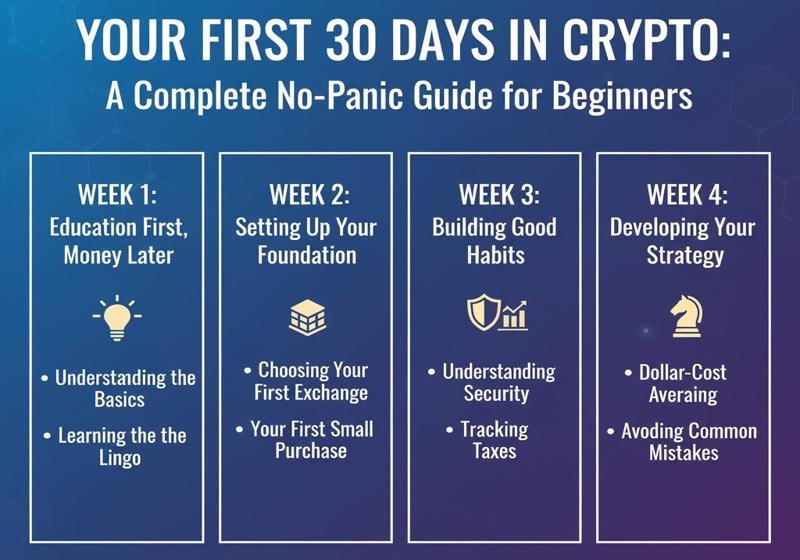
So you’ve decided to dip your toes into cryptocurrency. Maybe your cousin won’t stop talking about Bitcoin at family dinners, or perhaps you’re just curious about this digital money thing everyone keeps mentioning. Whatever brought you here, congratulations on taking the first step! This crypto for beginners guide will walk you through your first month without the overwhelming jargon or anxiety that often comes with entering this new space.
Here’s the thing: you don’t need to become a blockchain expert overnight. In fact, trying to learn everything at once is exactly what leads to panic and poor decisions. Instead, let’s break down your first 30 days into manageable chunks that’ll have you feeling confident without the stress.
Week 1: Education First, Money Later
Days 1-3: Understanding the Basics
Before you invest a single dollar, let’s get you comfortable with what crypto actually is. Think of these first few days as your orientation week.
Start by understanding that cryptocurrency is simply digital money that exists on a technology called blockchain. Unlike the dollars in your bank account, crypto isn’t controlled by any government or bank. Instead, it’s maintained by a network of computers around the world. Pretty cool, right?
For these first three days, watch a few beginner YouTube videos about Bitcoin and Ethereum. Don’t worry about understanding everything—just get familiar with the basic concepts. Moreover, read a couple of articles from reputable sources like CoinDesk or the official Bitcoin.org website.
Days 4-7: Learning the Lingo
Now that you’ve got the basics down, it’s time to learn the language. This crypto for beginners phase is crucial because the community loves its terminology.
Here are the essential terms you’ll encounter:
Wallet: Not a physical wallet, but a digital place where you store your crypto. Think of it like a special bank account that only you control.
Exchange: A platform where you buy, sell, and trade cryptocurrencies. It’s basically like a stock market app, but for crypto.
Blockchain: The technology that records all crypto transactions. Imagine a massive spreadsheet that everyone can see, but no one can cheat.
Private Key: Your secret password that proves you own your crypto. Lose this, and you lose your money—seriously.
HODL: A misspelling of “hold” that’s become crypto slang for holding onto your investment long-term, even when prices fluctuate.
Don’t memorize all of these at once. Instead, keep a notes app handy and jot down new terms as you encounter them. Additionally, join a beginner-friendly forum like r/CryptoCurrency on Reddit (but don’t take investment advice from strangers yet!).
Week 2: Setting Up Your Foundation
Days 8-10: Choosing Your First Exchange
Alright, you’ve done your homework. Now it’s time to set up shop. However, don’t rush into buying anything just yet.
For crypto for beginners, I recommend starting with a user-friendly, reputable exchange. The big names like Coinbase, Kraken, or Gemini are good choices because they’re regulated in the US and have strong security measures. They might charge slightly higher fees, but the peace of mind is worth it when you’re just starting.
Download the app or visit the website and create your account. You’ll need to verify your identity with a driver’s license or passport—this is normal and required by law. Furthermore, enable two-factor authentication (2FA) immediately. This adds an extra security layer by requiring a code from your phone whenever you log in.
Days 11-14: Your First Small Purchase
Here’s where things get exciting, but let’s keep it smart. For your very first purchase, invest only what you’d be comfortable losing. Seriously—pretend this money has already disappeared.
I recommend starting with just $50 to $100. Think of this as your “learning tuition.” You’re not trying to get rich; you’re getting familiar with how everything works.
Buy something simple like Bitcoin (BTC) or Ethereum (ETH). These are the most established cryptocurrencies with the longest track records. Once you hit that buy button, congratulations! You’re officially a crypto owner.
Nevertheless, don’t panic when you see the price moving up and down. This volatility is completely normal in crypto. In fact, you might refresh the app and see your $100 worth $98, then $103, then $95 all in the same day. That’s just how crypto works.
Week 3: Building Good Habits
Days 15-18: Understanding Security
Now that you own crypto, let’s talk about keeping it safe. This is perhaps the most important crypto for beginners lesson you’ll learn.
First, never share your private keys or seed phrase with anyone. Not your best friend, not someone claiming to be from customer support, not even someone who promises to “double your Bitcoin.” These are all scams.
Second, be wary of unsolicited messages. If someone DMs you on social media offering investment opportunities or “help” with crypto, it’s almost certainly a scam. Legitimate companies don’t reach out randomly.
Third, consider writing down your recovery phrase (the 12-24 words your wallet gives you) on paper and storing it somewhere safe. Don’t save it in a cloud service or email it to yourself. Old-school paper is actually more secure here.
Days 19-21: Tracking and Taxes
Here’s something many beginners overlook: you need to track your crypto for tax purposes. In most countries, including the US, cryptocurrency is treated as property, and you owe taxes on any gains.
Download a portfolio tracking app like CoinTracker or Blockfolio. These apps connect to your exchange and automatically track your purchases and current values. Moreover, they’ll help when tax season rolls around.
At this stage, you probably won’t owe much (or anything) in taxes since you’ve only bought a small amount. However, building this habit early will save you headaches later.
Week 4: Developing Your Strategy
Days 22-25: Dollar-Cost Averaging
By now, you’ve been watching the crypto market for three weeks. You’ve probably noticed that prices go up and down constantly. This is where a strategy called dollar-cost averaging (DCA) comes in handy.
Instead of trying to time the market (which even experts can’t do reliably), DCA means investing a small, fixed amount regularly—say, $25 every week or $100 every month. This smooths out the price swings over time.
Think of it like this: sometimes you’ll buy when prices are high, sometimes when they’re low. Over the long term, you’ll end up with an average price that’s probably pretty reasonable.
Set up a recurring buy on your exchange if you’re planning to continue investing. Otherwise, simply schedule a reminder to make manual purchases on the same day each week or month.
Days 26-28: Avoiding Common Mistakes
As you near the end of your first month, let’s talk about what NOT to do. These crypto for beginners pitfalls catch almost everyone at some point.
Don’t chase pumps: When you see a coin has gone up 50% today, your instinct might be to jump in. Resist this urge. What goes up quickly often comes down just as fast.
Don’t invest based on social media hype: That exciting new coin everyone’s talking about? It might be legitimate, or it might be a “pump and dump” scheme. Stick with established projects until you really know what you’re doing.
Don’t invest more than you can afford to lose: This can’t be stressed enough. Crypto is volatile and risky. Only invest money you won’t need for bills, emergencies, or daily life.
Don’t try to day trade: Professional traders with years of experience struggle to make money day trading. As a beginner, you’ll almost certainly lose money trying to buy and sell constantly.
Days 29-30: Planning Your Next Steps
Congratulations! You’ve made it through your first month. Take a moment to reflect on what you’ve learned and how you feel about your crypto journey so far.
For your next steps, consider:
- Continuing your education: Maybe dive deeper into how blockchain technology works or learn about different types of cryptocurrencies beyond Bitcoin and Ethereum.
- Expanding gradually: If you’re comfortable, you might slowly increase your monthly investment amount. Remember, slow and steady wins the race.
- Joining communities: Now that you understand the basics, you can participate more actively in crypto communities. Just remember to stay skeptical of too-good-to-be-true opportunities.
- Exploring DeFi cautiously: Decentralized Finance (DeFi) offers interesting opportunities, but it’s more complex and risky. Save this exploration for after you’re truly comfortable with the basics.
Final Thoughts for Your Crypto Journey
Your first 30 days in crypto don’t have to be scary. By taking it step by step, focusing on education before investment, and starting small, you’ve built a solid foundation without the panic.
This crypto for beginners approach emphasizes patience and learning over quick profits—and that’s exactly the mindset that leads to long-term success. The crypto space will still be here tomorrow, next month, and next year. There’s no rush.
Remember, everyone who’s now experienced in crypto was once exactly where you are today. They learned, made some mistakes, and grew more confident over time. You’re on the same path, and you’re already off to a great start by seeking out structured guidance.
Keep learning, stay humble, and never invest more than you can afford to lose. Welcome to crypto—your journey is just beginning.
Disclaimer: This article is for educational purposes only and is not financial advice. Cryptocurrency is highly volatile and risky. Only invest money you can afford to lose. Past performance is no guarantee of future results. Always do your own research and consider consulting a qualified financial advisor.
