Most people buy crypto the same way they pick a restaurant — based on a friend’s recommendation, a trending tweet, or a logo that looks cool. Then, weeks later, they discover the project was vague, overpromised, or outright fraudulent.
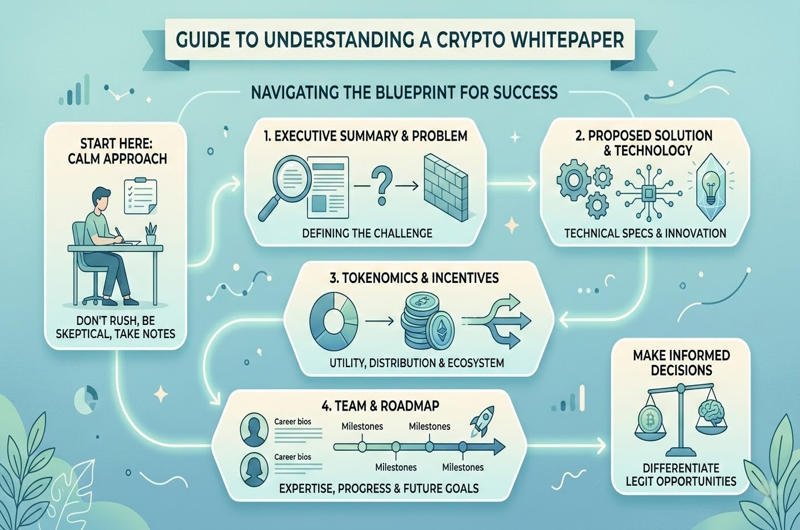
A whitepaper won’t save you from every bad investment, but it will filter out a lot of them. Here’s how to read a crypto whitepaper without a computer science degree.
What Even Is a Whitepaper?
A whitepaper is the founding document of a crypto project. Think of it as a combination of a business plan, a technical blueprint, and a pitch deck — usually published before or alongside a token launch.
It answers (or should answer) three core questions:
- What problem does this project solve?
- How does it solve it?
- Why does it need a token to do that?
Bitcoin’s whitepaper was nine pages. Ethereum’s was a little longer. Some modern whitepapers run to 80+ pages of dense technical writing. You don’t have to read every word, but you do need to know where to look and what to look for.
Before You Open It: Set the Right Expectations
A whitepaper is a proposal, not a guarantee. It describes what the team intends to build. Some of it may already exist; most of it probably doesn’t yet. Reading it means evaluating the quality of the idea and the credibility of the team — not confirming the product works.
Also, a well-written whitepaper doesn’t mean a good investment, and a technical-looking one doesn’t mean a legitimate project. Scammers can write polished documents. Your job is to read critically.
Step 1: Read the Abstract First
Almost every whitepaper opens with an abstract or executive summary — a one-to-two paragraph overview of the whole thing. Read this carefully before anything else.
Ask yourself: Can I understand what this project does in plain English after reading the abstract?
If the answer is no — if the abstract is packed with buzzwords but says nothing concrete — that’s a red flag. Legitimate projects can explain their purpose clearly. Vague language like “a next-generation decentralized ecosystem enabling frictionless value transfer” is often a sign that the team either doesn’t know what they’re building or doesn’t want you to.
Step 2: Identify the Problem Being Solved
Find the section where the team describes the problem their project addresses. This is usually near the beginning, sometimes called “Background,” “The Problem,” or “Motivation.”
Good problem statements are:
- Specific. “Cross-border payments currently take 3–5 business days and cost an average of 6.5% in fees” is specific. “The financial system is broken” is not.
- Real. Does this problem actually exist? Is it a meaningful inconvenience, or is the team inventing a problem to justify their solution?
- Unsolved (or poorly solved). Why haven’t existing solutions fixed this? The whitepaper should acknowledge competitors and explain the gap.
If you can’t identify a clear problem, stop. A project without a genuine problem to solve is a project without a reason to exist.
Step 3: Understand the Proposed Solution
This is usually the longest and most technical section. You won’t understand all of it, and that’s fine. Focus on the logic, not the jargon.
Try to answer these questions in your own words:
- How does the technology address the problem described?
- What’s the core mechanism — is this a blockchain, a layer-2 protocol, a DAO, a marketplace?
- Does the solution actually require a blockchain, or could it be done with a regular database?
That last question matters more than it sounds. Many projects add a token because tokens raise money, not because the technology requires one. If you can replace “blockchain” in the whitepaper with “spreadsheet” and the solution still makes sense, ask why the project needs to be decentralized at all.
Step 4: Check the Tokenomics
“Tokenomics” is just economics applied to a specific token — supply, distribution, and what gives the token value.
Look for a section covering:
Total supply. How many tokens will ever exist? A hard cap (like Bitcoin’s 21 million) is generally considered more trustworthy than an unlimited supply.
Distribution. Where do the tokens go at launch? A healthy split might look like: a portion for the public sale, a portion for the team, a portion reserved for ecosystem development. Watch out for projects where the team holds 40–50%+ of the supply — that’s a lot of selling power concentrated in a few hands.
Vesting schedules. Are team tokens locked for a period of time before they can be sold? Vesting schedules are a good sign; they mean the team has an incentive to build something that grows in value rather than dump and disappear.
FDV vs. market cap. Fully Diluted Valuation (FDV) is what the entire token supply would be worth at the current price — including tokens not yet in circulation. If the FDV is dramatically higher than the current market cap, it means a large number of tokens are still waiting to be unlocked and sold. That future supply hitting the market can suppress price significantly. It’s one of the more common and overlooked red flags in newer launches.
Token utility. What does the token actually do? Does it pay for network fees, grant governance votes, unlock features? A token with no clear utility is just a speculative asset — which some people are fine with, but you should know that going in.
Step 5: Read the Roadmap
A roadmap shows what the team plans to build and when. Look at it with healthy skepticism.
Check if any milestones have already passed. Did they hit their targets? Missed deadlines aren’t automatically disqualifying — software development is unpredictable — but a trail of missed promises without explanation is a warning sign.
Look for specificity. “Q3 2026: mainnet launch” is better than “Phase 2: ecosystem expansion.” Vague milestones can never technically be missed.
Notice what’s missing. A roadmap that ends six months from now might mean the team hasn’t planned beyond the fundraise. A strong project should have a long-term vision, even if the near-term steps are most detailed.
Step 6: Evaluate the Team
Many whitepapers include a section on the founders and core team. This is worth spending real time on.
- Are the names real and verifiable? Search for them on LinkedIn. Do their backgrounds match the claims in the whitepaper?
- Have they worked on other crypto projects? What happened to those projects?
- Is the team anonymous? Anonymous teams aren’t inherently fraudulent — Bitcoin’s creator is pseudonymous — but an anonymous team building a centralized financial product with no audits deserves extra scrutiny.
- Has the project’s code been audited? Check whether the whitepaper links to audits from firms like CertiK or PeckShield, and whether those audit reports are publicly accessible. A linked audit you can’t actually find or verify is worth little.
Also, check whether the project has credible advisors or investors listed. These can be faked, but a genuine connection to known entities in the space adds some accountability..
Step 7: Look for Risk Disclosures
Legitimate projects acknowledge what could go wrong. Look for a section on risks, limitations, or challenges.
If the whitepaper reads like pure marketing — all upside, no risk — be cautious. Honest teams know their technology has limitations, that regulation is uncertain, and that competitors exist. A project that doesn’t mention any of this is either naive or not being straight with you.
What to Do With Technical Sections You Don’t Understand
Skip them — for now.
Seriously. You don’t need to understand the cryptographic primitives in a consensus mechanism to evaluate whether a project is worth your attention. Focus on what you can understand: the problem, the logic of the solution, the team, and the economics.
If you want to go deeper, copy a confusing passage and search for it or ask an AI to explain it in plain terms. But don’t let technical density intimidate you into skipping the whitepaper entirely. The sections that matter most are usually written in accessible language.
Green Flags and Red Flags at a Glance
Green flags:
- Clear problem with cited evidence
- Solution that logically addresses the problem
- Token utility that makes sense within the ecosystem
- Named, verifiable team with relevant experience
- Honest risk disclosures
- References to academic papers or prior work
- References to audits, open-source code on GitHub with recent activity.
Red flags:
- Buzzword-heavy language with no substance
- No clear explanation of why a token is needed
- Team tokens with no vesting or lock-up periods
- Roadmap with no past milestones or all future ones are vague
- No mention of competitors or risks
- Guaranteed returns or promises of revolutionary disruption
- Heavy focus on AI/memecoins without clear mechanics
The Bigger Picture
Reading a whitepaper won’t make you an expert, and it won’t eliminate investment risk. But it will put you in a very different position than someone who bought based on a trending hashtag.
The goal isn’t to understand everything. It’s to ask better questions — and to notice when a project can’t answer them.
Once you’ve read the whitepaper, take it one step further: cross-check claims against on-chain data. DefiLlama lets you verify a protocol’s Total Value Locked (TVL) — useful for any DeFi project claiming significant adoption. Dune Analytics has community-built dashboards showing real transaction activity, wallet growth, and usage patterns. What a team writes in a document and what’s actually happening on-chain can tell very different stories.
Start with Bitcoin’s whitepaper if you haven’t. It’s nine pages, written in 2008, and it’s still one of the clearest documents in the industry. Then read one for a project you’re curious about. You’ll be surprised how much you can pick up.
Disclaimer: This article is for educational purposes only and is not financial advice. Cryptocurrency is highly volatile and risky. Only invest money you can afford to lose. Past performance is no guarantee of future results. Always do your own research and consider consulting a qualified financial advisor.
