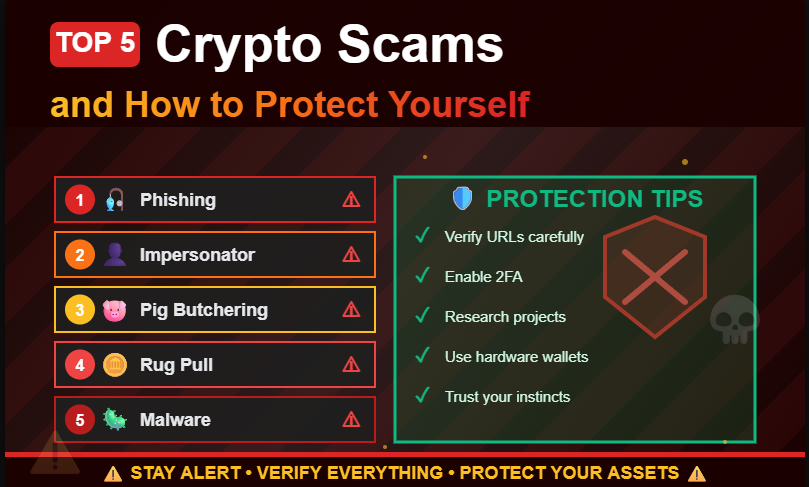
Learn about the 5 most common cryptocurrency scams targeting beginners and discover essential security practices to protect your digital assets from theft and how to avoid crypto scams.
Quick Security Checklist
✓ Never share your seed phrase with anyone
✓ Bookmark official exchange websites
✓ Enable two-factor authentication (2FA)
✓ Verify wallet addresses before sending funds
✓ Research projects before investing (DYOR)
The Real Threat Isn’t a Market Crash
Let’s be honest: when you’re new to crypto, watching Bitcoin drop 10% in a day feels terrifying. But here’s what keeps me up at night, and what should worry you more—losing everything to a scammer.
I’ve seen too many people get into crypto, ignore basic security, and then watch helplessly as their funds disappear. The worst part? Unlike your bank account, there’s no “cancel transaction” button. No customer service rep who can reverse the charge. Once your crypto is gone, it’s gone forever. So, how to avoid crypto scams?
The good news is that most crypto scams follow the same playbook. Once you know what to look for, they’re surprisingly easy to spot and avoid.
The One Rule That Trumps Everything Else
Before we dive into specific scams, let’s talk about your seed phrase. This is usually 12 or 24 random words that act as the master key to your wallet. Think of it like having the password to your bank account, but a thousand times more important.
Here’s the deal: nobody legitimate will ever ask for your seed phrase. Ever.
Not Coinbase support. Not the MetaMask team. Not Vitalik Buterin sliding into your DMs. If someone asks for it, they’re trying to rob you. It’s that simple.
I can’t stress this enough because it’s the number one way people lose their crypto. Keep those words written down somewhere safe (not on your computer), and treat them like you would a key to a safe full of cash.
The 5 Scams That Target Beginners (And How to Avoid Them)
1. Phishing Scams: The Fake Website Trap
You get an email that looks exactly like one from Binance. “Urgent: Security Alert!” it screams. There’s a link. You click it. The website looks perfect—same logo, same layout, same everything.
Except it’s not Binance. It’s a fake site designed to steal your login info.
This happened to a friend of mine last year. He lost $3,000 in five minutes because he didn’t check the URL. The fake site was “binannce.com” instead of “binance.com.” One extra ‘n’ cost him three grand.
Here’s how to avoid crypto scams and how you stay safe:
The best trick I’ve learned is to bookmark the real websites and only use those bookmarks. Never click email links. Ever. I know it seems paranoid, but that paranoia keeps your money safe.
Also, get in the habit of actually looking at URLs. It takes two seconds. Those two seconds might save you thousands of dollars.
2. The Fake Support Scam
This one’s sneaky because it preys on people who are already confused and looking for help.
Picture this: You’re having trouble with your wallet and post about it on Twitter. Within literally minutes, you get a reply from what looks like official support. They’ve got the logo, the professional tone, everything. “DM us and we’ll fix this right away!”
You DM them. They ask you to “verify your wallet” by entering your seed phrase on some sketchy website.
Game over.
Real crypto support teams don’t work this way. They don’t DM you first. They don’t ask for your seed phrase. They don’t pressure you to act fast.
When you need help, go directly to the official website and use their contact form. Yes, it might take longer. But it also means you won’t lose all your money to some scammer in Romania.
3. Pig Butchering: The Romance Scam That Drains Your Wallet
This is probably the most heartbreaking scam I’ve seen, and it’s way more common than you’d think.
It starts innocently enough. Someone matches with you on a dating app or reaches out on Instagram. They’re attractive, successful, and surprisingly interested in you. You chat for weeks, maybe months. They share photos, personal stories, the whole nine yards.
Then comes the investment talk. “Hey, I’ve been making amazing returns on this new crypto platform. Want me to show you how it works?”
They’re patient. You invest a little, and you can actually withdraw it! So you invest more. Then more. Then they suggest going big on this “once in a lifetime opportunity.”
You put in $10,000, $50,000, sometimes more. And suddenly, they’re gone. The platform won’t let you withdraw. The person stops responding.
The scam is called “pig butchering” because they’re literally fattening you up before the slaughter. It’s calculated, cold, and devastating.
Red flags to watch for:
- Someone you barely know gives you investment advice
- They push you toward a specific platform you’ve never heard of
- Returns sound way too good (20%+ per month? Come on)
- They get pushy when you hesitate
If someone you met online is talking about crypto investments, hit pause. Do your research on platforms separately. And honestly? Keep your dating life and your investment decisions completely separate.
4. Rug Pulls: When the “Next Bitcoin” Vanishes Overnight
New crypto projects launch every single day. Most are legitimate. Some are scams designed to steal your money from day one.
Here’s how it works: A team creates a new token, let’s call it “MoonRocket.” They build hype on Twitter and TikTok with promises of revolutionary technology. They might even get some crypto influencers to promote it. The website looks professional, the whitepaper sounds impressive.
People start buying in. The price shoots up. Everyone’s making money!
Then one day, the developers drain all the money from the project and disappear. The token becomes worthless. Millions of dollars vanish.
I’ve seen this happen dozens of times. There was this one NFT project last year that raised $2.8 million and vanished within 24 hours. People thought they were buying into the next Bored Apes. They got nothing.
How to protect yourself:
Do your homework before investing in anything new. I’m talking serious research:
- Who’s behind the project? Are they real people with LinkedIn profiles and track records?
- Has the code been audited by a reputable security firm?
- Is the project solving an actual problem, or just promising vague “moon” gains?
- What’s the team’s history with previous projects?
If the team is anonymous and the project sounds too good to be true, walk away. There will always be another opportunity. Don’t FOMO into losing your money.
5. Malware: The Silent Wallet Thief
This one’s subtle but devastating.
You download what you think is a free game, a movie, or even a crypto portfolio tracker. Seems harmless enough. But hidden inside is malware that monitors your computer.
When you copy a wallet address to send crypto, the malware swaps it with the scammer’s address in a split second. If you don’t notice, your money goes straight to the thief.
I know someone who lost $15,000 this way. He was sending USDC to his own wallet on another exchange. Copied the address, pasted it, hit send. Didn’t check it carefully. The malware had swapped the address. His $15,000 went to some random wallet in who-knows-where.
Your defense is simple but critical:
Before you click send, check that address. I mean really check it. Look at the first four characters. Look at the last four characters. Make sure they match what you copied.
It takes five extra seconds. Those five seconds saved me once when I noticed the address had changed. Almost sent $8,000 to a scammer.
Also, keep your computer clean. Update your antivirus. Don’t download sketchy stuff. And for larger amounts, consider using a hardware wallet that’s never connected to the internet.
Beyond Avoiding Scams: Building Real Security
Okay, so now you know what to avoid. But let’s talk about what you should actively do to keep your crypto safe.
Get serious about two-factor authentication (2FA). Not the SMS kind—those can be hacked through SIM swapping. Use Google Authenticator or Authy. It’s an extra step, sure, but it’s also an extra layer between hackers and your money.
Don’t keep everything on exchanges. Coinbase and Binance are great, but they’re also giant targets for hackers. For crypto you’re holding long-term, move it to a wallet you control. For really large amounts, get a hardware wallet like a Ledger or Trezor.
Test transactions with small amounts first. Sending to a new address? Send $10 first to make sure it works. Once it arrives, send the rest. This has saved me from costly typos more than once.
Never talk about how much crypto you own. Seriously, just don’t. Not on social media, not at parties, nowhere. It makes you a target. The people who brag about their holdings are the ones who end up getting hacked or scammed.
The Red Flags That Scream “This Is a Scam”
You’ll develop an instinct for this (and how to avoid crypto scams) over time, but here are the obvious warning signs:
Someone promises guaranteed returns? Scam. There’s no such thing in crypto or anywhere else.
They’re rushing you to invest right now or you’ll miss out? Scam. Legitimate opportunities don’t disappear in the next 20 minutes.
They ask for your seed phrase for any reason whatsoever? Definitely a scam.
You got a DM from “support” that you didn’t initiate contact with? Scam.
The website URL looks slightly off or has weird grammar? Probably a scam.
“Send me 1 ETH and I’ll send you back 2 ETH?” Come on. Obviously a scam.
Trust your gut. If something feels off, it probably is.
Common Questions I Get Asked About Crypto Security
“I think I got scammed. What do I do?”
First, if you still have access to your wallet, move everything to a new wallet with a new seed phrase immediately. Then report it to the platform where it happened and to law enforcement. Unfortunately, getting your money back is unlikely, but reporting it helps protect others.
“Do I really need a hardware wallet if I’m just starting out?”
If you’ve got less than $500 in crypto, probably not yet. But once you’re holding serious money, absolutely yes. They’re around $60-150 and worth every penny for the security they provide.
“How do I know if a new crypto project is legit?”
Look up the team on LinkedIn. Check if the smart contract has been audited. Read what people are saying on Reddit and Twitter (not just the project’s own posts). See if they have locked liquidity. If you can’t find solid info on any of these, don’t invest.
“Can I recover crypto sent to the wrong address?”
Nope. That’s why you always send a test transaction first. Always.
Final Thoughts: This Stuff Actually Matters
I know this all sounds paranoid and overwhelming. When you’re starting out, crypto can feel like you need a computer science degree just to not get robbed.
But here’s the thing: once you build these habits, they become second nature. Checking URLs takes two seconds. Verifying addresses before sending becomes automatic. Ignoring DMs from “support” becomes instinct.
The technology behind crypto is actually incredibly secure. It’s the human side where things go wrong. Scammers aren’t breaking cryptography—they’re manipulating people who don’t know better.
Now you know better how to avoid crypto scams.
Stay skeptical, stay careful, and never stop learning. The scammers are always evolving their tactics, so you need to keep evolving your defenses.
And hey, if this article helped you, share it with someone who’s new to crypto. The more people who understand these scams, the harder it becomes for scammers to succeed.
Want to Go Deeper?
- What are Gas Fees and Why Did They Cost Me So Much?
- Hot vs. Cold Wallets: Which is Safer for a Beginner?
- Buying Your First Bitcoin Safely: The 5-Step Absolute Beginner’s Guide
Disclaimer: This article is for educational purposes only and doesn’t constitute financial advice. Do your own research before making any investment decisions.
Disclaimer: This article is for educational purposes only and is not financial advice. Cryptocurrency is highly volatile and risky. Only invest money you can afford to lose. Past performance is no guarantee of future results. Always do your own research and consider consulting a qualified financial advisor.
