If you’re new to cryptocurrency and wondering what are gas fees, you’re not alone—it’s one of the most common questions for anyone using networks like Ethereum. Simply put, gas fees are the small payments you make to cover the computational power needed to process and validate transactions or smart contracts on a blockchain.
Think of it like fuel for a car: Just as your vehicle needs gas to run, every action on Ethereum (sending ETH, swapping tokens on a DEX, or minting an NFT) requires “gas” to power the network’s validators.
These fees are paid in ETH and measured in gwei (a tiny fraction of ETH—1 gwei = 0.000000001 ETH).
What are gas fees used for exactly? They compensate validators for securing the network, prevent spam attacks, and prioritize transactions during busy times. After Ethereum’s EIP-1559 upgrade, fees include a base fee (automatically adjusted by network demand and partially burned to reduce ETH supply) plus an optional tip for faster processing.
Quick Checklist: Why Gas Fees Matter
✓ They pay validators for processing your transaction
✓ They stop spam attacks on the network
✓ They let you “bid” for faster confirmation when it’s busy
Why Do Gas Fees Exist?
Gas fees aren’t just random charges—they keep the whole system running smoothly:
- Reward Validators: People (or staking pools) run powerful computers to verify and add your transaction to the blockchain. Gas fees compensate them for the electricity and work.
- Stop Spam: Without a cost, bad actors could flood the network with junk transactions. Fees make that too expensive.
- Handle Busy Times: When everyone’s transacting (e.g., during a hot NFT drop), fees act like an auction—higher payers get priority.
A friend once lost out on a mint because he set his fee too low; his transaction sat forever while others zoomed past.
How Gas Fees Are Calculated
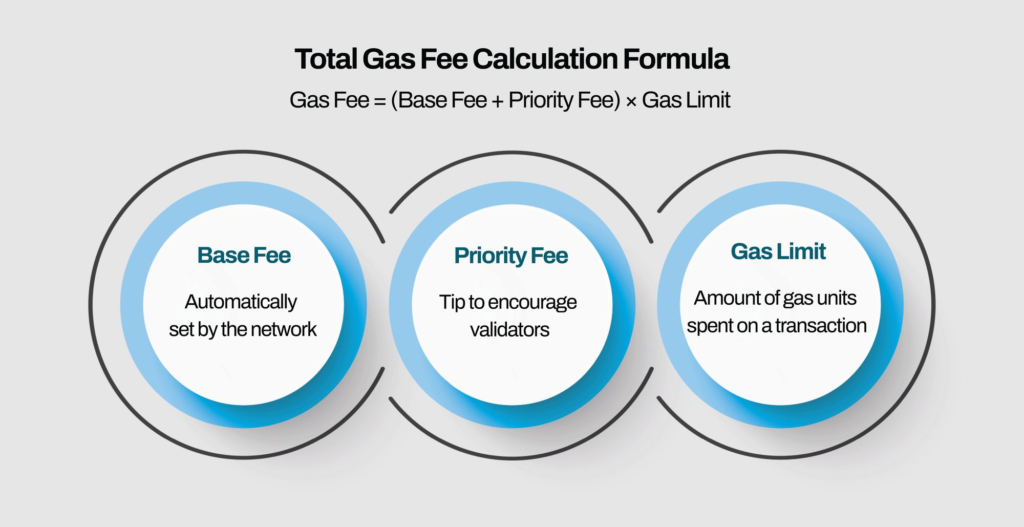
It’s simple math: Estimated/Max Possible Fee = (Base Fee + Priority Fee) × Gas Limit
Base Fee: Automatically set by the network (based on congestion) and burned (removed from circulation).
Priority Fee (Tip): What you add to incentivize faster inclusion—goes to validators.
Gas Limit: Your estimated maximum gas units (same as before—to prevent infinite loops).
- Gas Units Used: Depends on complexity.
- Simple ETH send: ~21,000 units (cheap!).
- Swapping tokens or using a dApp: 100,000+ units (more work = more gas).
- Gas Price: It fluctuates with demand.
- Right now, prices are super low (around 0.03 gwei average), so a simple transfer might cost pennies.
- During peaks, it can spike to 100+ gwei, turning a $5 action into $50+.
Most wallets (like MetaMask) handle this for you, suggesting safe fees.
Real-Time Gas Trackers (Essential Tool!)
Always check a tracker before transacting—it’s like checking traffic before driving.
Popular free ones:
- Etherscan Gas Tracker
- Blocknative Gas Estimator
- Dune Gas Fees Dashboard
How to Avoid High Gas Fees (Beginner Tips)
Don’t worry—high fees aren’t constant anymore, thanks to upgrades and Layer 2 solutions.
- Time It Right: Fees are lowest during off-peak hours (e.g., late night US time or weekends). Use a tracker to wait for green/low zones.
- Switch to Layer 2 (Best Fix!): These are “side roads” built on Ethereum—same security, but way faster and cheaper (often under $0.10 per transaction).Popular ones in 2025:
- Arbitrum
- Base
- Optimism
- Polygon
- zkSync
- Use Low-Fee Chains for Simple Stuff: If you don’t need Ethereum’s full ecosystem, try Solana or other fast networks.
Final Thoughts
Gas fees are a “necessary evil” for a decentralized network—no central bank to cover costs! But with Layer 2 booming, they’re rarely painful anymore. Start small, check trackers, and you’ll save a ton.
You’ve got this—happy transacting! 🚀
Disclaimer: This article is for educational purposes only and is not financial advice. Cryptocurrency is highly volatile and risky. Only invest money you can afford to lose. Past performance is no guarantee of future results. Always do your own research and consider consulting a qualified financial advisor.
